
How to Choose a Press Brake: Tonnage, Material, and Machine Type
Over the past 30+ years, Empire has helped hundreds of customers find the right press brake for their operation. There are numerous options on the market — four main types, each with different performance characteristics — and a significant amount to work through before you commit: material requirements, tonnage, bend length, back gauge configuration, clamping, software, and post-sale support.
This guide covers the criteria our customers most commonly consider when making their purchase.
NOT SURE WHAT'S RIGHT FOR YOUR SHOP?
Get Expert Guidance First
Every operation is different. Empire's press brake specialists can walk you through your material requirements, production volume, and floor space — so you know exactly what you're getting into before you commit.
Quick Self-assessment
Before comparing models, work through these questions first:
- What materials will you primarily be bending — aluminum, mild steel, stainless? What are the thicknesses?
- What is the maximum part length and depth you need to form?
- How much tonnage do you currently need, and how much might you need in the next five years as your business grows?
- Is your facility limited to single-phase power, or do you have three-phase available?
- How often do you switch between different jobs and tooling setups? High-mix, short-run work has different clamping and back gauge requirements than high-volume production.
- What floor space is available, including clearance at the rear and sides of the machine?
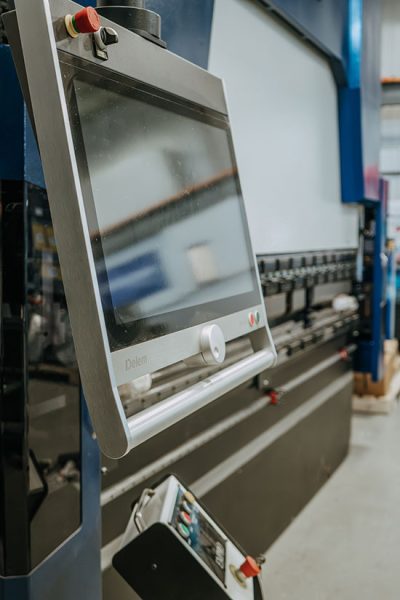
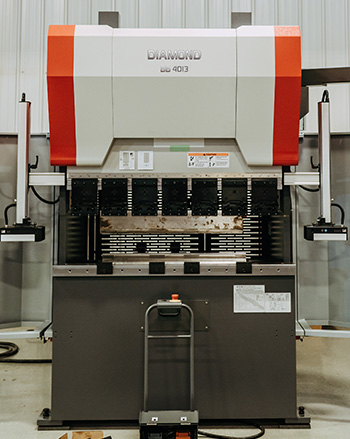
Types of Press Brakes
There are four main types of press brakes on the market. There's no single right answer, only the machine that best suits your needs.
1. Pneumatic Press Brakes
Pneumatic press brakes run on compressed air — ideal where three-phase power isn't available. They're easy to operate, low-maintenance, and among the safest options, capable of stopping at any point if necessary. The main trade-off is lower tonnage availability.
2. Hydraulic Press Brakes (Synchro)
Hydraulic press brakes are the most popular on the market for their high tonnage capacities, reliability, low energy requirements, and safety features. Each hydraulic cylinder is controlled independently but operates in sync via a CNC or NC control system. Hundreds of manufacturers produce this style — don't be fooled by appearance or fit and finish. Look closely at the hydraulic and electrical components and verify they're made by reputable name-brand companies. With an investment of this size, you need confidence the machine will hold up years after the warranty ends.
3. Servo Electric Press Brakes
Servo electric press brakes use servo motors to drive ball screws or a belt drive — no hydraulic cylinders. They're approximately 30% faster than hydraulic and use about 50% less energy, available in 20–300 tons up to 12 feet. Fewer manufacturers produce these, keeping prices higher than hydraulic equivalents.
4. Hybrid Press Brakes
Hybrid press brakes combine the tonnage of a conventional hydraulic machine with the precision of a servo electric. A servo motor and ball screw control the high-speed down-stroke; once the ram reaches the mute point, the hydraulics take over to apply bending tonnage, then the servo and ball screw return the ram to top of stroke.
Material Considerations
Three criteria determine the size requirements for your press brake: the type, size, and thickness of the material you'll be processing.
Type of Material
Press brakes work with aluminum, steel, stainless steel, and other materials. Tensile strength drives tonnage requirements — and the differences are significant. Aluminum requires approximately 50% less tonnage than mild steel at the same thickness; stainless requires approximately 50% more.
Maximum Sheet Size
The largest pieces you'll form dictate the length and throat depth you need. All press brakes have C-shaped side frame cut-outs — the throat — that limit bend depth on parts longer than the frame width. A 12' press brake has approximately 10'2" to 10'6" between side frames; if you're bending 10' parts, a 12' machine is your minimum.
Maximum Sheet Thickness
Thicker material requires higher tonnage — covered in detail in the full guide. If you're primarily bending 14 gauge and lighter, a CNC folder or panel bender may be a better fit. See our Folders Buyer's Guide.
Pro tip: rather than sizing for your current minimum tonnage and maximum bend length, factor in where your business is heading. Buy for where you're going, not where you are now.
Frequently Asked Questions
Post-Sale Service
Post-sale service is one of the most important factors in a press brake purchase. Machine quality today is generally high, but when something does go wrong, downtime is expensive — it takes directly from your productivity and profits. The difference between a responsive vendor and a slow one can mean the difference between hitting a deadline and missing it. When talking to any vendor, ask:
- Can the vendor provide remote internet connectivity to the machine for support? How quickly can they access and diagnose an issue?
- How fast can replacement parts be sourced and delivered?
- Can a technician reach your shop in a reasonable timeframe, or support you virtually when needed?
- For pre-owned machines: are parts and software support still available for the controls?
Empire has operated a complete in-house service department since 1987, with experienced, factory-trained technicians available for Canada-wide on-site service.
Ready to Find the Right Press Brake for Your Shop?
A press brake is a significant capital investment. The right machine depends on your materials, tonnage requirements, part complexity, production mix, and where your operation is headed. Getting those variables right before you buy is what Empire's specialists are here for.
Empire has been helping Canadian and U.S. shops find the right metal fabrication equipment since 1987. We stock new, pre-owned, and reconditioned press brakes, accept trade-ins, sell on consignment, and back used equipment with a 30-day guarantee. Whether you're comparing machine types, sorting out tonnage and sizing, or evaluating new versus used, our team can walk through your specific situation.
Browse Empire's press brakes, download the full Buyer's Guide PDF, or contact one of our Product Specialists directly.
The Complete Resource
Download the Full Press Brake Buyer's Guide PDF
Get the complete deep-dive — tonnage charts, tooling detail, back gauge configurations, and 30+ years of industry expertise from Empire's specialists.