
Structural steel fabrication has automated unevenly. Cutting, drilling and coping have moved onto CNC equipment in a lot of shops, while fitting and welding are still done largely by hand, and shops are finding it harder to hire the tradespeople who do that work. AGT Robotics puts welding at more than 35% of all fabrication processes, which makes it the largest block of manual work left in most structural shops.
That is usually what brings a shop to us, and the question becomes which process to automate first, so the crew already in the building spends it’s time on work that needs their judgment.
Once a shop starts processing beams faster, the welding department has to keep up. Install a welding robot first, and the opposite can happen: the robot waits while the saws, mag drills and coping station work through the next beam.
We’ve seen both. It’s why the Machitech BeamCut and AGT Robotics BeamMaster often end up in the same building. The BeamCut handles cutting, holes, copes and layout marks, and after fitting, the BeamMaster welds the assembly.
Which one comes first depends on where work is piling up.
Getting a Beam Ready for Welding
Manual beam processing involves a lot of handling and measuring. For a single beam, someone has to:
- Lay out hole locations, copes and connection points
- Position a mag drill for each hole
- Cut the beam to length and burn in the copes
- Position and tack the connection plates and stiffeners
- Weld out the assembly, which on a beam with plenty of attachments can mean two hours of arc time
A layout error early in that sequence carries through to fitting.
One fabricator we worked with measured his processing time before buying a BeamCut. His shop averaged 42 minutes per stick, and with the machine installed that dropped to seven minutes.
42 minutes per stick, down to seven.
What the BeamCut Takes Off Your Crew’s Hands
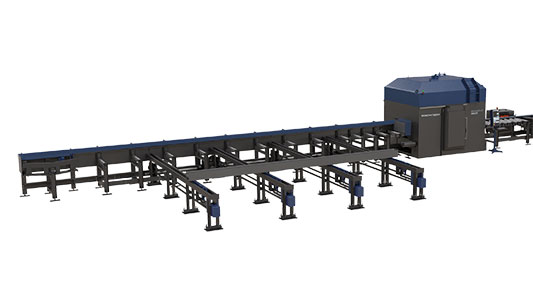
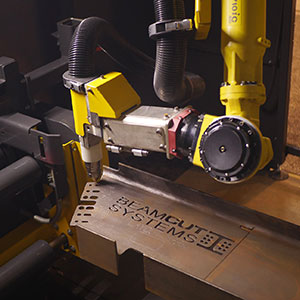
The BeamCut uses a six-axis FANUC robot fitted with a Hypertherm XPR plasma torch, positioned between infeed and outfeed conveyors. In one cell it cuts holes, slots, copes, bevels and cuts the beam to length, combining work otherwise spread across a drill line, punch, coping station and band saw. Machitech states that Beamcut meets AISC and CISC requirements for thermally cut holes in structural bolted connections.
Before cutting, laser measuring devices profile the steel on the conveyor so the machine works to the actual section rather than the nominal dimensions in the drawing, since the shape that arrives from the mill doesn’t always match the model. The machine reads NC1, DSTV and 3D CAD files directly, carrying the geometry from detailing into production without someone entering it again.
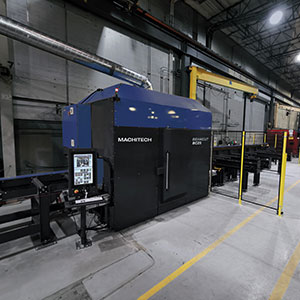
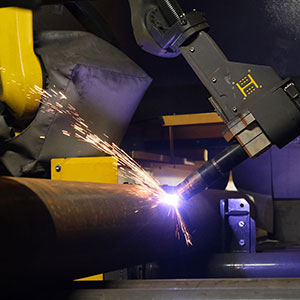
The BeamCut comes in two models.
| Model | Maximum beam size | Processing |
|---|---|---|
| BC25 | Approximately 30 x 12 inches | Plasma |
| BC50 | Approximately 48 x 16 inches | Plasma, with optional in-line drill unit |
The BeamCut can also mark attachment locations, and those marks carry through to fitting, reducing the layout work needed to position connection plates and stiffeners.
How the BeamMaster Handles Finish Welding
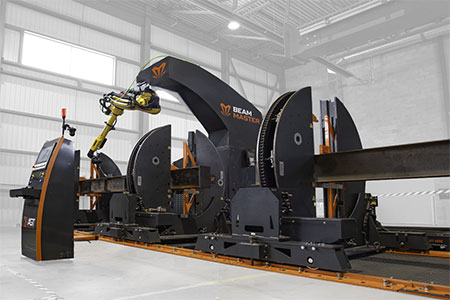
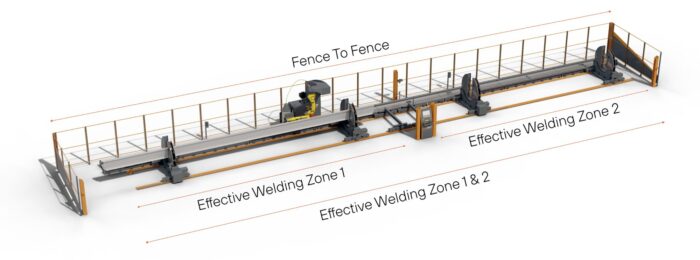
The BeamMaster is a robotic welding cell for structural steel, combining a rail-mounted FANUC welding robot, a Lincoln Electric welding source and powered rotators that take beams up to 48 inches wide. Once the fitted beam is loaded, the rotators turn it to present the welds in the horizontal position, which reduces overhead and vertical welding and saves the crane handling needed to reposition the assembly.
Before welding begins, AGT’s SnapCam 3D camera scans the assembly and adjusts the program so the robot locates the actual joints, not where the model says they should be.
AGT reports output three to four times that of manual welding, with one operator producing the equivalent of up to four welders. The result in any shop will depend on its assemblies, weld requirements and ability to keep fitted work coming to the cell.
A welding robot needs a steady supply of work, which is where beam processing and fitting become part of the same equipment decision.
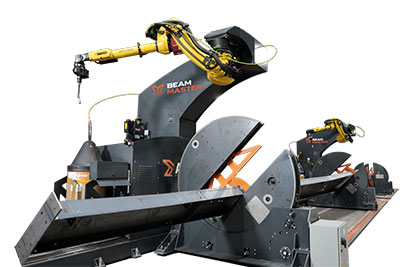
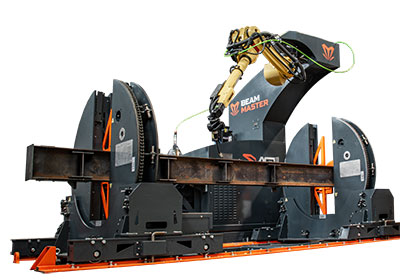
Moving Work Through Both Machines
With both in place, fitters use the BeamCut’s marks to position and tack the plates and stiffeners, and the fitted assembly moves to the BeamMaster while the crew starts the next piece.
The marks reduce repeated measuring; they don’t remove the need for skilled fitting.
Some assemblies suit the robot better than others, and a shop needs a way to decide which work goes where.
AGT’s Cortex software can process a building model and provide a weld-efficiency figure for each beam, so the shop can set a threshold for robotic welding and route the remaining pieces to manual welders.
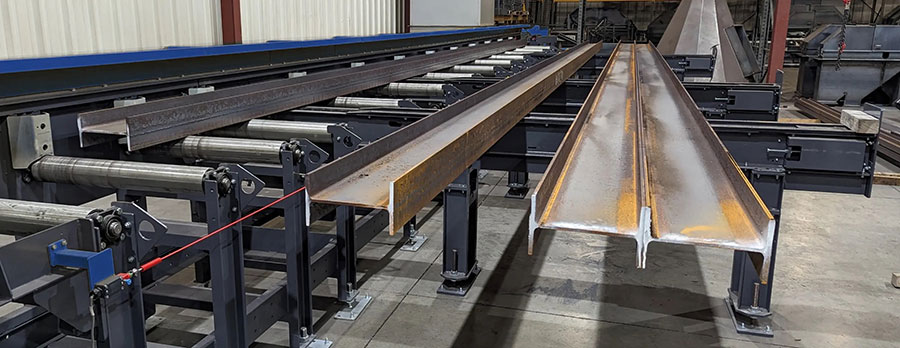
Programming For One-Off Assemblies
Structural fabrication rarely involves long runs of identical parts. A building may contain many similar beams, each with different plates, stiffeners or weld details, and programming each one by hand would consume much of the time a robot is meant to save.
Cortex generates individual welding programs from 3D models produced in Tekla, SDS2, Advance Steel or Bocad, and can batch-process the model so the shop prepares programs for unique assemblies without teaching each one at the robot.
When comparing systems, ask how the programming is handled:
- Can your own staff process the model, or does it go back to the supplier?
- What is the turnaround when a program needs changing?
- What ongoing fees apply, and are they annual or per job?
With AGT, Cortex runs locally and is operated by the shop’s own staff, and Machitech offers the BeamCut without an annual software subscription. Those details affect operating costs and how much control you have over production.
Which Machine Should Come First?
Start with the department that is holding up completed work.
For shops that can’t hire enough welders, the BeamMaster may be the first purchase. Existing beam-processing equipment continues feeding the shop while the robot takes on finish welding, and some welders can move into fitting, where their experience helps prepare assemblies for the cell.
If welding is keeping up but cutting, coping and drilling are falling behind, the BeamCut is the more immediate fit.
The fabricator who went from 42 minutes to seven started with beam processing. He later moved from a BC25 to a BC50 and is now considering a BeamMaster, because as cutting capacity increased, welding became the next constraint.
You don’t necessarily need both machines at once. You do need to consider what the next department can handle before increasing output from the one ahead of it.
Planning the Floor Space and Staffing
The cell’s footprint is only part of the space calculation. Beams need somewhere to wait before processing, room for fitting and a clear route into and out of welding.
AGT also builds the LayoutMaster, a separate machine that works alongside the BeamMaster as a fitting assistant, using laser projection to show part outlines, positions and weld details directly on the beam so fitters work from the projection rather than from a drawing and a tape measure.
AGT puts the combined BeamMaster and LayoutMaster footprint at roughly one-third of the space required for an equivalent volume of manual welding. How that fits your material flow depends on the work mix, crane access and how the fitting crew supplies the cell.
Once loaded and running, the robot can continue welding while the operator takes a break or prepares the next assembly, and where the installation and operating procedures allow it, a beam loaded near the end of the shift can be completed after the crew leaves.
Those gains depend on preparation. The cell needs fitted beams ready to load, and the operator needs time and support to keep work moving.
Canadian Manufacturing and Support
Both machines are built in Quebec. AGT Robotics is based in Trois-Rivières and has more than 30 years of experience engineering robotic welding systems, and Machitech manufactures the BeamCut at St-Marc-des-Carrières and Victoriaville.
For Canadian fabricators, having the manufacturer in the country matters when arranging installation, training, parts and technical support. Delivery terms and currency are worth discussing with the supplier as part of the purchase.
More details and Specifications on the AGT Robotics BeamMaster
More details and Specifications on the Machitech BeamCut
Start With Your Own Work
Bring what you have:
- Representative part drawings
- Annual tonnage
- Current welder and fitter numbers
- Dimensions of the bays you’re considering
- Any processing or welding time studies
That gives us enough to look at where your shop is losing time, which assemblies suit automation and whether processing or welding should come first.
We’ve spent the last several years installing this equipment in Canadian shops. Get in touch to review your parts and process, and we can work out where either machine would earn its place.