
Consider an 8ft sheet of 14-gauge mild steel being formed into an enclosure panel, with the first bend two inches in from the edge. On a press brake, the operator supports the rest of the sheet out in front of the machine, and that material rises as the ram descends, then has to be brought back down when the ram retracts. On a part that size most shops put a second operator on it, or bring in a crane or sheet followers to carry the weight through the stroke.
The same sheet on a folder lies flat on the back gauge table. The edge is clamped, the folding beam swings up to form the flange, and the rest of the panel never moves. One operator runs the part.
So, the question is, does your metal fabrication shop need a folder? Whether a folder earns a place beside your press brake(s) depends on your part mix. Get that wrong, and you add a machine that leaves the bottleneck exactly where it was.
Two Things Shops Get Wrong About Folders
The first is that folders are limited to light architectural gauge — flashing, trim and thin pre-painted stock. That is where folding machines built their reputation, but it is not the limit of the technology. Empire supplies folders capable of bending up to 5/8″ plate – the Evo Heavy Duty has the capacity to fold up to ⅝” (16 mm) mild steel.
The second assumption is the more costly one. A shop that already owns press brakes often concludes it has no use for a folder, so when bending capacity runs short the response is to add another brake. That adds more of the capability the shop already has; if what’s slowing the shop down is how many people it takes to move a panel, a second press brake leaves that constraint exactly where it was.
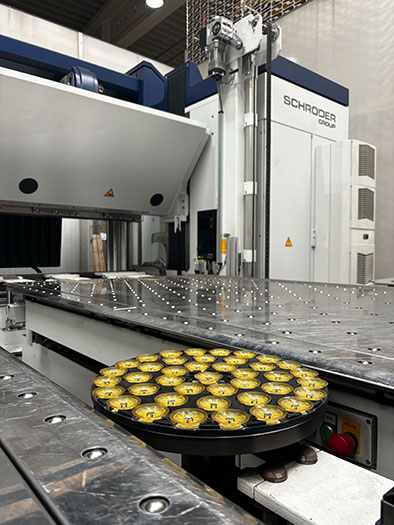
Bend Consistency on Each Machine
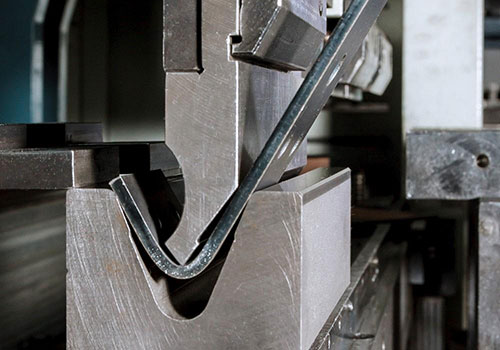
A press brake drives a punch down into a die. The workpiece rotates around the tooling as the bend forms, which means any material hanging past the die has to travel with it.
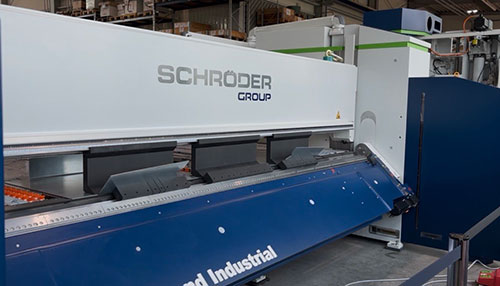
A folder follows a fixed sequence of position, clamp and bend. The blank is gauged from the rear, clamped beneath an upper nose bar — a solid bar or segmented fingers, depending on the work — and a lower beam swings upward to fold the flange along the length of the part.
That gauging method is why folded parts come out consistent. Because every bend references the same gauged position, inaccuracy in the blank is absorbed into the first flange formed. On a box or pan, that means any error in the blank ends up in the height of the outer flange rather than in the size of the box itself. The inside dimensions come out right, which are usually the ones that matter at assembly.
Tooling and Setup: The Hours That Disappear Between Jobs
On a press brake, the punch and die are matched to material thickness and part geometry, so a change of job means a change of tooling. Shops running a busy brake keep a rack of it, and because material slides across the shoulders of the lower die on every hit, that tooling wears and eventually has to be replaced.
A folder’s tooling stays on the machine. Within its rated capacity it will form the thicknesses and angles a job requires without a tooling change: the operator calls up the program and runs the part. The segmented clamping fingers may need repositioning for box and pan work, but tools are not swapped between jobs.
Press brake manufacturers are aware of this gap. Hydraulic clamping and automatic tool changers both reduce setup time, and both work well, but they are addressing a constraint folding technology does not have.
Where a Press Brake Remains the Right Machine
1. Thick plate
is the clearest case. Folders reach a thickness ceiling; press brake tonnage continues well past it, and heavy plate work will always belong on a brake.
2. Small Parts
Small parts are the second. A part an operator can pick up and turn by hand moves through a press brake faster than it does being positioned across a folder table.
3. Hemming
Hemming is a third: a folder’s hemming capacity sits below its bending capacity—a machine rated to bend 16 gauge may be rated to hem only 24 gauge—so a press brake remains the right choice for flat hems beyond the folder’s hemming capacity.
The reasoning runs in the other direction as well. A shop that bought a folder for large panels can end up with its most capable machine occupied by small parts. The answer there is a small press brake alongside it, or a robotic one where the volume supports it, so the folder stays on the work it was bought for.
Where a Folder Is the Better Choice
1. Large Panels
Large panels are the obvious case: a job that takes two operators on a press brake takes one on a folder. It also reduces strain on the people running it: two operators maneuvering a large panel through a press brake stroke, shift after shift, carries a fatigue and injury risk that never appears on a quote.
2. Surface Finish
Surface finish is the second case. Because the material stays supported on the back gauge table and is clamped rather than driven into a die, polished, coated and pre-painted stock comes off a folder without the marking or distortion a die can leave along the bend line.
Folders also suit parts with high bend counts, where the operator is not flipping and re-gauging the part between bends, and small flanges on large sheets, where a press brake means handling a whole panel to form a half-inch return.
What Happens Downstream: Cost That Shows Up After Bending
For a single formed part, bending is the last operation and the part ships. For an assembly the formed parts still have to be joined and finished, and two things about the bending stage carry into that.
Accuracy comes first. Parts formed to consistent dimensions sit together more closely at fit-up, which means less grinding and shimming before anything is welded. That matters more where a robot is doing the welding, since it repeats the same programmed path on every part and cannot adjust for a gap the way a human welder would.
Scheduling is the larger effect. Take an assembly of five formed parts. When setup is expensive, production gets batched: 25 pieces of the first part, a changeover, 25 of the second, and so on. The first batch waits on the floor until the fifth is finished, because assembly cannot begin until every part is present. With no changeover between them, a folder can run one of each and release a complete kit.
Does your work justify a folder?
Answer these 6 questions based on your last month of work.
- How much of your work sits inside a folder’s rated thickness?
- How often does a part need more than one operator, a crane or sheet followers on the press brake?
- How much of it carries a surface finish a die can mark?
- How much of it is welded into an assembly afterward?
- How often does a job wait on the floor because the rest of its kit hasn’t been formed?
- How often does the press brake change setup in a shift?
One job that would have run faster on a folder is a job you work around. A month of them is a capacity problem.
Know Before You Shop
Press brakes and folders are not specified the same way. Sizing a press brake means accounting for tonnage, throat depth, daylight, stroke and deflection. Buyers also need to look beyond the advertised bending length. A press brake’s full bending length extends beyond the clearance between its side frames. Depending on the part’s geometry, throat depth can then limit how far it can be positioned into the machine, and some bends may require a different forming approach. A folder does not have that same side-frame and throat-depth limitation. Before choosing either machine, confirm how it will handle the dimensions and bend sequence of the parts you plan to make.
Floor space needs the same planning. A folder’s footprint runs ten to twelve feet depending on its size and back gauge configuration, with room needed to stage laser-cut blanks going in and formed parts coming out. Think about how parts will move from cutting to bending when deciding where it belongs. A press brake needs roughly 3ft clear at the rear and room at the sides to slide tooling in and out. Check the space requirements of the specific machine before planning its position on the floor.
Beyond that, running both is a routing decision made job by job, with one objective: neither machine doing work the other one does better.
As we say at Empire, buy for where you’re going, not where you are now.