
Buying a rollformer is one of the larger capital decisions a shop will make. Get it right and the machine pays for itself. Get it wrong and you have equipment that doesn’t fit your market, sitting on your floor.
The right answer looks completely different depending on where you operate. A shop in an agricultural region may need a wide format machine before ever considering standing seam. A custom residential contractor in a suburban market has the opposite problem. The same machine can be a smart investment in one location and a poor one in another.
For some shops, a rollformer is their first major machine investment. Others are putting in million-dollar production lines. This article covers the main decision points. Think of it as a starting point.
Empire Machinery has spent years helping contractors and manufacturers work through this decision — understanding their market, the products their customers actually want to buy, and which rollforming machine configuration makes sense for their operation.
What Applies to Your Situation?
| Article Section | The Question It Answers | |
|---|---|---|
| ✓ | Portable vs. In-Plant | Do I need job-site production, or will I produce panels in a shop and deliver? |
| ✓ | Fixed-Profile vs. Multi-Profile | Do I need to run one panel type, or will my work mix require switching profiles? |
| ✓ | Standing Seam vs. Wide Format | What panel types does my market actually buy — custom residential, agricultural, commercial? |
| ✓ | Snap Lock vs. Mechanical Seam | What roof slopes and weather conditions will I be working with? |
| ✓ | Machine Size and Scale | Do I understand how much size varies within each category, and what that means for my floor space and production planning? |
| ✓ | Decision Framework | How do I put it all together and figure out which machine type fits my business? |
Portable vs. In-Plant Rollforming Machines
Rollforming machines fall into two operating environments. This is the first decision, and everything else follows.
Portable Rollformers
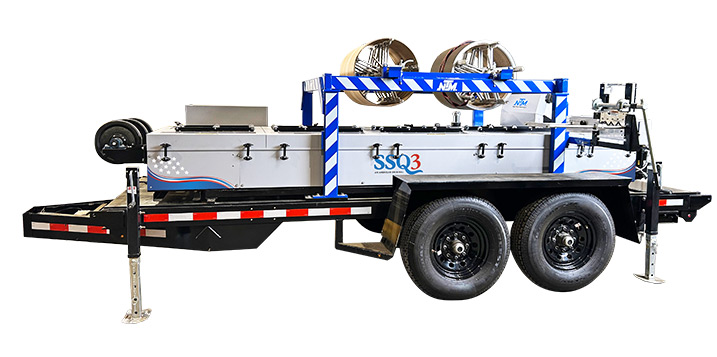
Portable rollformers go directly to the job site. Mounted on trailers or compact frames, they produce panels on demand and cut them to exact length in the field. That eliminates the waste and coordination overhead of ordering pre-cut panels from a supplier.
Portable machines suit residential and commercial contractors. They handle panel widths up to 24″ and are most commonly used for:
- Standing seam (snap lock and mechanical seam profiles)
- Flush wall and board and batten profiles (depending on tooling)
- Soffit with perforations
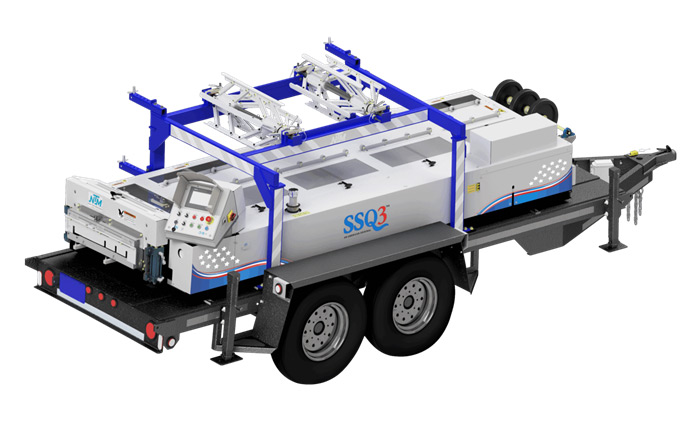
— SSQ3 MultiPro Portable Rollformer
In-Plant Rollformers
In-plant rollformers stay in the shop. Panels are produced in volume, bundled, and delivered to site. They run faster, have more robust forming stations, produce more consistent results over long runs, and can handle wider panels than portables.
This category covers a wide range of machines — from compact in-plant units not much larger than a portable, to high-speed wide format systems that fill a warehouse, require cranes for tooling changes, run at 200 feet per minute, and need auto-stacking equipment just to keep up with output. Both are ‘in-plant.’ Understanding where in that range you actually need to be is as important as the portable vs. in-plant distinction itself.
Shops producing panels for multiple crews or for resale typically rely on in-plant equipment.
Portable vs. In-Plant: Key Comparison
| Factor | Portable Rollformers | In-Plant Rollformers |
|---|---|---|
| Location | Job site (trailer or compact frame) | Fixed shop environment |
| Panel Length | Cut to exact length on-site | Pre-produced, bundled for delivery |
| Panel Width | Up to 24″ typically | Up to 60″ depending on machine type |
| Best For | Residential and commercial contractors | Shops producing panels for multiple crews or for resale |
Fixed-Profile vs. Multi-Profile Rollforming Machines
Once you know your operating environment, the next question is profile flexibility — your ability to serve different markets and respond to diverse panel types.
Fixed-Profile Machines
Fixed-profile rollformers have tooling for one panel type. A gutter machine is a good example: it makes one thing efficiently, and that’s the point. The same logic applies to a shop running thousands of feet of corrugated panel every week — a single-profile machine at high volume is often the right call.
Fixed-profile machines offer lower initial cost and high reliability. The tradeoff: if your business grows and you need a different panel type, you’re buying another machine. That also means more floor space.
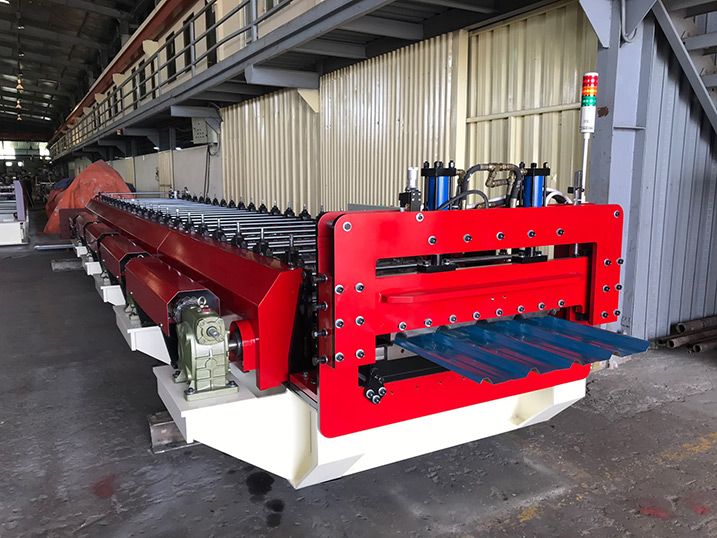
— Vietsteel Wide Coverage Panel Rollformer
Multi-Profile Machines with Manual Changeover
Multi-profile rollformers can run different profiles from a single machine. Each profile requires its own dedicated tooling set, sometimes called rafts. The cost per profile is lower than buying a separate machine for each panel type.
Changeover is done by hand, removing and replacing roll sections or rafts. On a smaller portable machine, this takes an hour to half a day. On a large in-plant machine, the rafts are substantial — you need crane access to move them and floor space to store them. When a raft is out, you’re not producing that profile. Changeover on large equipment can take a full day or more. Build that downtime into your production planning before committing.
These machines suit growing shops with a diversifying work mix that need flexibility without buying multiple dedicated rollformers.
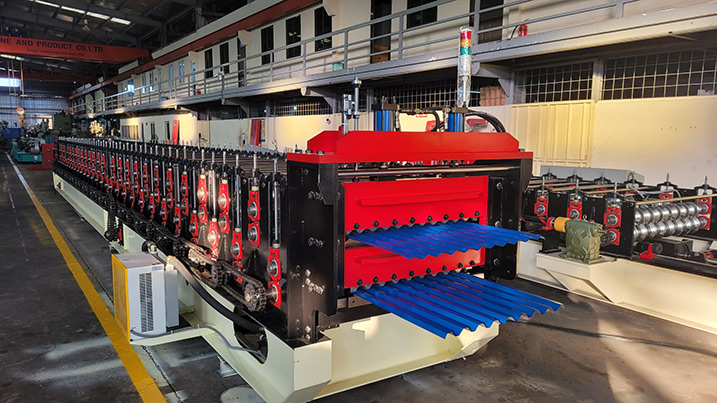
— Vietsteel Double Deck Rollformer for Wide Coverage Panels
Cassette and Rapid-Change Systems
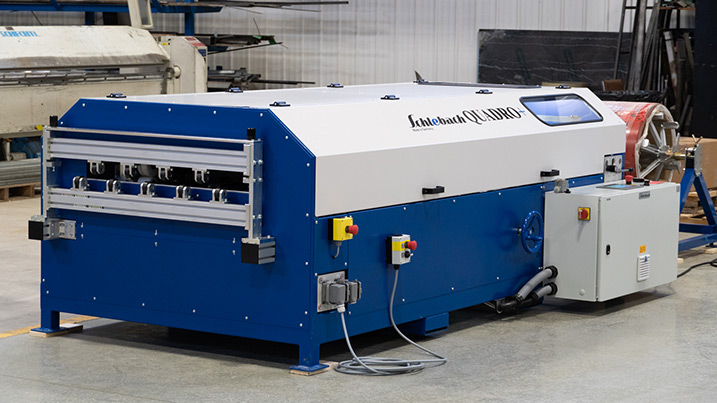
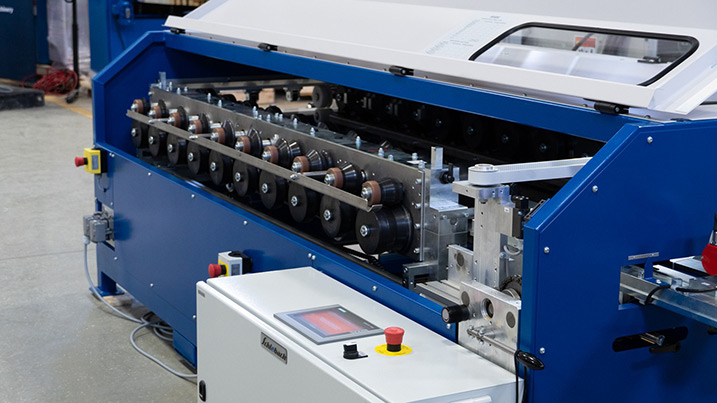
Systems like the Schlebach Quadro Plus change profiles as a single pre-aligned unit instead of roll by roll. Changeover time is 2 minutes or less. These are in-plant machines built for shops running multiple profile changes per day.
Additional cassettes must be stored on-site when not in use. Higher initial investment and storage requirements are the tradeoffs for the speed advantage.
Fixed-Profile vs. Multi-Profile: Key Comparison
| Factor | Fixed-Profile | Multi-Profile Manual | Cassette / Rapid-Change |
|---|---|---|---|
| Changeover Time | N/A | Hours to days (varies significantly by machine size) | ~2 minutes (e.g. Schlebach Quadro Plus) |
| Environment | Portable or in-plant | Portable or in-plant | In-plant |
| Best For | Single-profile specialists or high-volume single-profile operations | Growing contractors with a mixed and expanding work profile | Multi-service in-plant operations running multiple profile changes daily |
| Key Constraint | No profile switching — additional machines required for other panel types | Changeover downtime and raft storage must be factored into production planning | Higher cost; additional cassettes require dedicated storage on-site |
Standing Seam vs. Wide Format Rollforming Machines
This is where market and location start to drive the decision more than machine specs alone.
Standing Seam Rollformers
Standing seam rollformers are available in portable and in-plant configurations, making them versatile across residential and commercial markets. Machines in this category produce panels up to 24″ wide and cover the standard material range: painted steel (24 to 30 gauge), aluminum, and copper.
Standing seam is associated with residential and higher-end commercial applications: custom homes, architectural projects, premium work where the finish commands a premium price. In markets where that work is available, margins are generally better than on commodity panel production. Panels are run to exact length on-site or in-plant, cutting waste and simplifying logistics.
Wide Format Rollformers
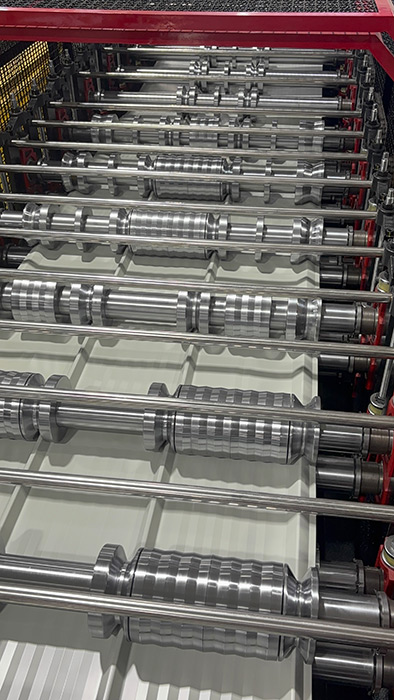
Wide format rollformers are large, fixed in-plant machines designed for high-volume panel production. They produce panels up to 60″ wide, which are bundled and delivered to site. They require adequate floor space, run-out tables, and material handling infrastructure. At the high end, auto-stacking equipment is required because at 200 feet per minute, panels come off the line faster than a crew can manage manually.
Wide format makes sense in agricultural and rural markets with strong demand for corrugated barn panels. The catch: those panels are widely available through distributors. When a product is available everywhere, pricing gets fixed and margins thin out. Whether producing them yourself makes economic sense depends on your volume and your location.
The stronger case for wide format is a shop producing multiple profile types at volume across a full building envelope: corrugated, standing seam, board and batten, flush wall, soffit panels. That range opens more bids and more margin.
A Note on Forming Processes
Standing seam machines use edge forming, shaping panels from the edges inward. Wide format machines producing exposed fastener panels — AG, PBR, corrugated — use center-out forming. These are different forming processes. The machines are not interchangeable. Most established operations eventually run both types because the markets they serve are different.
— Vietsteel Wide Coverage Panel Rollformer
Standing Seam vs. Wide Format: Key Comparison
| Factor | Standing Seam Machines | Wide Format Machines |
|---|---|---|
| Panel Width | Up to 24″ | Up to 60″ |
| Profile Options | 1–14 | Multiple dedicated profiles |
| Production Speed | Up to 80 ft/min | Up to 200 ft/min (high-end systems) |
| Environment | Portable or in-plant | In-plant only |
| Best Applications | Residential, commercial, custom architectural work | Agricultural, commercial, high-volume production for delivery |
Snap Lock vs. Mechanical Seam
Within standing seam, this distinction determines which applications your machine is suited for.
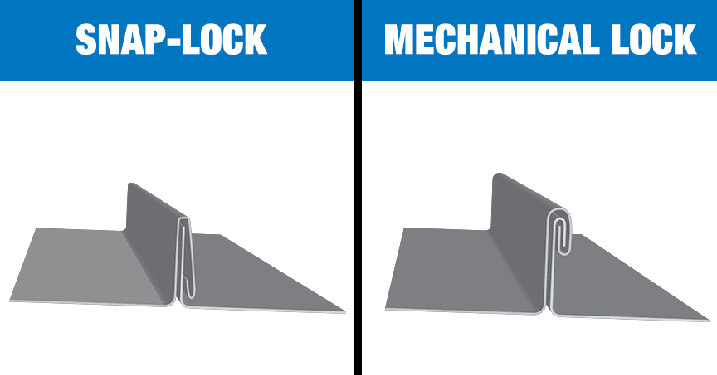
Snap lock panels click into place without a seaming tool, making installation faster with less specialized labour. They work well for residential applications on slopes of 3:12 or greater.
Snap lock is not appropriate for lower-slope applications. The connection doesn’t create a tight enough seal to prevent water infiltration when drainage is slow. Below 3:12, mechanical seam is required.
Mechanical seam panels are crimped together with a hand or electric seamer. That adds labour, but creates a tighter, more weather-resistant joint. Use mechanical seam for low-slope applications, high wind uplift requirements, and longer panel runs where thermal movement needs to be managed.
Understanding Machine Size and Scale
One of the most common sources of confusion when researching rollforming machines: the word ‘in-plant’ covers an enormous range.
A compact in-plant standing seam machine might sit in a small shop, run at 40–80 feet per minute, and be operated by one person. A high-speed wide format in-plant machine is a different category entirely: it can occupy a large portion of a production floor, produce panels up to 60″ wide at up to 200 feet per minute, require a crane to swap tooling, and need a dedicated auto-stacking system to handle output.
Machine size drives three practical decisions:
- Floor space requirements — compact machines fit in smaller shops; large format machines require dedicated production floor planning
- Changeover complexity — on small machines, a profile changeover takes an hour or two; on large machines, it can take a full day, requiring crane access and raft storage
- Production speed and volume — larger machines run faster and produce more, but the infrastructure investment is proportionally higher
If you’re in the market for your first in-plant machine, understanding this range is important. The investment and operational requirements at opposite ends of the in-plant category are very different.
Choosing the Right Rollformer: Decision Framework
Machine specs are secondary. These are the questions that determine which rollformer fits your business.
- What does your market want to buy? Corrugated barn panels, custom standing seam, or a mix?
- Where are you located? An agricultural area and a suburban residential market have different answers.
- Do you need panels at the job site, or will you produce and deliver from a shop?
- Will you specialize in one profile, or do you need to switch between profiles?
- How much floor space do you have, and what can you allocate to infrastructure like run-out tables and raft storage?
Rollformer Types by Use Case
| Machine Type | Choose If… | Key Constraint |
|---|---|---|
| Fixed-Profile | You run one panel type at high volume — corrugated barn panels, snap lock residential. No need to switch profiles. | No profile switching. Additional machines required for other panel types. |
| Multi-Profile Manual | Your work mix is growing and you change profiles occasionally. You can absorb changeover downtime. | Changeover ranges from hours (small machine) to a full day or more (large in-plant). Raft storage required. |
| Cassette / Rapid-Change | You run multiple profile changes per day and need production to keep moving. In-plant use only. | Higher initial investment. Additional cassettes require dedicated on-site storage. |
| Wide Format In-Plant | You need high-volume production of larger panels for delivery to site — agricultural, commercial, or architectural. | Significant floor space, run-out tables, and material handling required. Not portable. |
Ready to Talk Through Your Options?
Rollforming is a deep subject, and this guide only scratches the surface. We haven’t covered how rollforming works alongside folding, or the cases where folding is the better choice entirely. The right configuration for your operation — machine size, speed, profile tooling, accessories — takes a conversation, not a spec sheet.
Empire Machinery works with contractors and manufacturers to figure out what actually makes sense for their operation, their market, and their budget. If you want to walk through your situation, we’re happy to have that conversation.
Get in touch today. We can discuss your work mix, your location, your growth plans, and help you figure out where to start.